
The Non-Volley Zone (The Kitchen) Explained: A Simple Breakdown of What You Can and Can’t Do

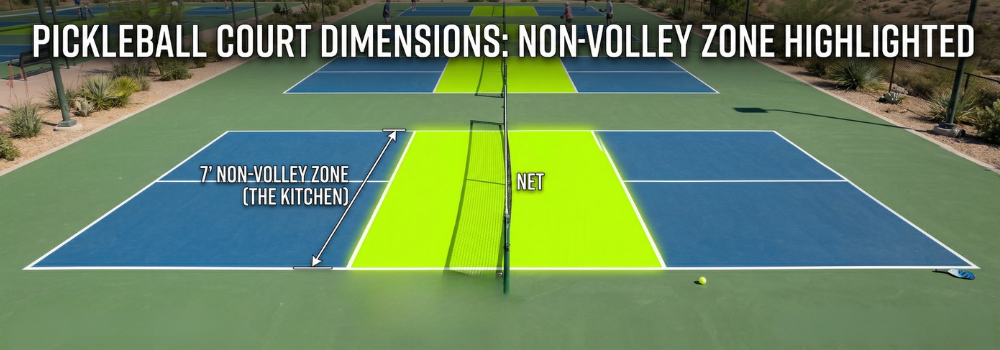
If you have spent even a few minutes around a pickleball court, you have undoubtedly heard the frantic cries of “Watch the kitchen!” or “That’s a momentum fault!” For new and transitioning players, the most perplexing element of pickleball is a 7-foot rectangle painted on both sides of the net. Officially known in the USA Pickleball rulebook as the Non-Volley Zone (NVZ), this area is universally referred to by players as “the kitchen.”
The kitchen is the great equalizer of pickleball. It was brilliantly designed to prevent tall, powerful players from simply camping right at the net and aggressively smashing every single ball out of the air. By forcing players to step back to hit volleys, the kitchen creates the necessity for the delicate “dink” shot, transforming pickleball from a game of pure, brute force into a highly strategic chess match.
Despite its simple premise, the kitchen is the source of more arguments, misunderstood rules, and accidental faults than anything else on the court. Here is your comprehensive, easy-to-understand guide to exactly what you can, cannot, and absolutely should do in the pickleball kitchen.
The Golden Rule: No Volleys in the Kitchen
The foundational rule of the Non-Volley Zone is incredibly straightforward: You cannot volley the ball while standing in the kitchen.
A volley is defined as striking the ball out of the air before it has bounced on the ground. If you hit a volley, your feet must be completely outside of the kitchen. Furthermore, the painted line marking the non-volley zone is considered part of the kitchen itself. If even a millimeter of your toe is touching the kitchen line when your paddle makes contact with a volley, you have committed a fault, and you automatically lose the rally.
It’s Not Just About Your Feet
The rule extends far beyond where your shoes are planted. You cannot volley the ball while any part of you, or anything attached to you, touches the kitchen. If you hit a brilliant volley out of the air, but your sunglasses fall off your face and land in the kitchen, it is a fault. If your hat drops, your towel slips out of your pocket, or your paddle scrapes the ground inside the non-volley zone during the act of volleying, the rally is immediately lost.
Busting the Biggest Kitchen Myths
Because the kitchen rules carry severe penalties, many recreational players develop an irrational fear of the area, leading to the creation of widespread myths. Let’s clear them up:
Myth #1: “The Kitchen is Lava” (You can never step in it)
Fact: You can step into the kitchen at absolutely any time during a match! You can stand in the kitchen, walk through the kitchen, or dance in the kitchen. The restriction only applies to hitting volleys. If your opponent hits a soft dink that bounces inside the kitchen, you are fully expected to step into the kitchen, let the ball bounce, and hit it back.
Myth #2: “The Hover Rule” (You can’t cross the plane of the line)
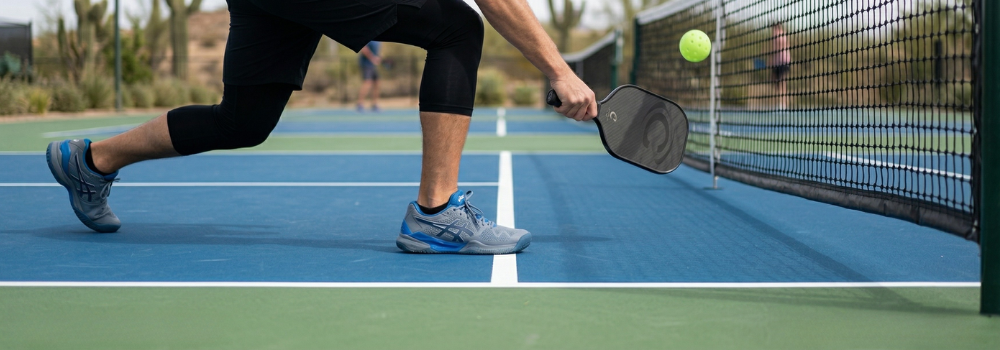
Fact: The pickleball kitchen is a two-dimensional space on the ground; it is not a three-dimensional forcefield. You are perfectly allowed to physically reach your arm and paddle across the vertical plane of the kitchen line to hit a volley out of the air, provided that your feet stay firmly planted outside the line and you do not physically touch the ground inside the zone.
Myth #3: “You can jump and hit from the kitchen if you land outside”
Fact: You must establish your position outside the kitchen before hitting a volley. You cannot start inside the kitchen, jump up, hit the ball in mid-air, and land outside. If you were standing in the kitchen to return a bounced ball, you must physically step both feet completely out of the kitchen (re-establishing your position) before you are legally allowed to hit a volley again.
The Momentum Rule Demystified
This is where the vast majority of arguments start during open play. Rule 9.C of the USA Pickleball rulebook governs momentum, and it is ruthlessly strict.
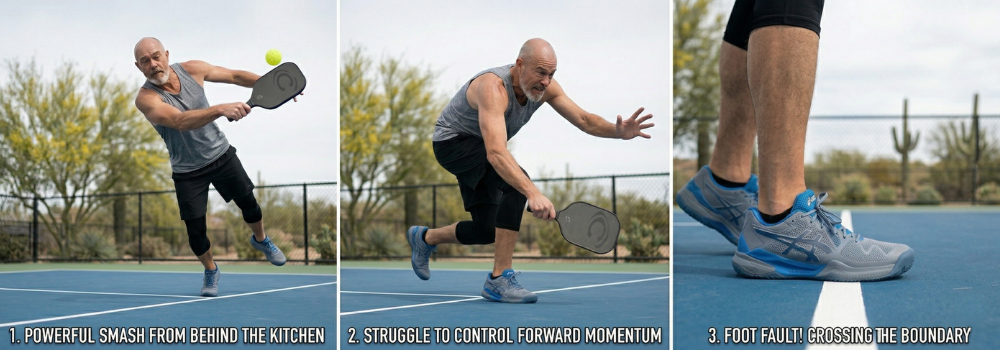
The act of volleying includes your setup, your swing, your follow-through, and the momentum generated by your body. If you execute a legal volley with your feet safely behind the line, but your forward momentum carries your body forward so that you step into the kitchen (or onto the line) after you hit the ball, it is a momentum fault.
Crucially, it does not matter if the ball is already dead. For example, imagine you hit a thunderous overhead volley that bounces twice before your opponent can even react. The point should be yours, right? Not if your momentum causes you to stumble into the kitchen two seconds later. Even if you hit an outright winner, if your momentum subsequently carries you into the non-volley zone before you have regained complete balance and control of your body, you lose the point.
The “Partner Save” and the 2-Becomes-1 Rule
Here is a fun quirk of the momentum rule: if you hit a volley and your momentum is pulling you forward into the kitchen, your partner is legally allowed to grab your shirt or your waist and physically pull you back to stop you from committing a fault!
However, players must be aware of the “2-Becomes-1 Rule.” If your partner is already standing inside the kitchen (perhaps they just returned a dink), and you bump into them while your momentum carries you forward from a volley, you inherit their court position. Because they are touching the kitchen, and you touched them, you are deemed to have touched the kitchen, resulting in a fault.
Adaptive Play: The Wheelchair Kitchen Rules
As pickleball grows, its adaptive rules have evolved to accommodate players of all physical abilities. In 2026, the rules for wheelchair players interacting with the Non-Volley Zone were further clarified.
For athletes competing in a wheelchair, the front (smaller) wheels of the chair are completely exempt from the kitchen rule. A player may volley the ball even if their small front casters are resting inside the non-volley zone. However, the large rear wheels act as the player’s “feet.” If the large rear wheels touch the NVZ line or inside the kitchen while the ball is live during a volley, or if momentum carries the rear wheels into the kitchen after a volley, it is a fault.
Advanced Exceptions: The Erne and the ATP
Once players master the basic restrictions of the kitchen, they can utilize advanced, highly offensive shots that skirt the very edges of the NVZ boundaries.
The Erne: Named after Erne Perry, who popularized the shot in competitive play, this is an aggressive maneuver where a player anticipates a shot near the sideline, rapidly moves (or jumps) completely outside the physical boundaries of the court, and smashes the ball out of the air right next to the net. Because the player establishes both feet completely outside the sideline rather than inside the NVZ, it is a completely legal volley that legally bypasses the kitchen entirely.
The ATP (Around the Post): When an opponent hits a sharp, angled shot that pulls you far off the sideline, you do not actually have to hit the ball back over the net. The rules allow you to hit the ball low and completely around the outside of the net post, provided the ball lands cleanly in your opponent’s court. The kitchen rules still apply here—your momentum from hitting the ATP cannot carry you into the NVZ or cross into your opponent’s side of the court.
Why Is It Even Called “The Kitchen”?
While the official rulebook rigidly refers to it as the “Non-Volley Zone,” no one uses that mouthful on the courts. But where did the culinary nickname originate?
While there are a few humorous theories—such as the action getting “too hot in the kitchen”—the true origin likely comes from the game of shuffleboard. In traditional shuffleboard, there is a penalty area located behind the primary scoring zones known as the “10-off” zone. For decades, shuffleboard players colloquially referred to this penalty box as “the kitchen,” warning each other to stay out of it. Because pickleball borrowed elements from various recreational sports during its invention, the terminology naturally carried over. You don’t want to get caught in the shuffleboard kitchen, and you certainly don’t want to get caught volleying in the pickleball kitchen!