
The Ultimate “When to Replace” Checklist: Diagnosing Dead Paddles, Lateral Footwear Failure, and Equipment Degradation in 2026
The evolution of pickleball from a casual backyard pastime into a highly organized, technologically advanced global sport has precipitated a revolution in equipment manufacturing. As the global pickleball equipment market surges toward a projected valuation of over three billion dollars by the early 2030s, the sophistication of the gear has grown exponentially. Modern players are no longer wielding modified wooden table tennis paddles; they are utilizing aerospace-grade carbon fiber composite structures, thermodynamic polymers, and highly engineered biomechanical footwear. However, this shift toward high-performance materials introduces a critical challenge for the modern athlete: the management of equipment degradation.
Unlike a wooden paddle or a traditional canvas sneaker, which might simply endure until catastrophic breakage, modern composite materials and specialized athletic foams possess highly finite, functional lifespans. The degradation of these materials is rarely immediate or highly visible. Instead, it manifests through a subtle, insidious decline in performance that silently sabotages a player’s mechanics, reduces their competitive efficacy, and drastically increases the risk of acute and chronic injuries. Every microscopic impact of the ball against the paddle face, and every violent lateral lunge across the hardcourt, subtracts from the structural integrity of the gear.
This comprehensive research report serves as the definitive educational checklist for the Center Court Pickleball Club community. It provides rigorous material science and biomechanical frameworks to diagnose a “dead” pickleball paddle, evaluate the lateral support integrity of court shoes, and manage the lifecycle of ancillary gear ranging from safety eyewear to equipment bags. By mastering these diagnostic protocols, players can maintain a competitive edge, prevent kinetic chain injuries, and make highly informed, data-driven decisions when visiting the Center Court Pickleball Club pro shop.
Part 1: The Material Science of Pickleball Paddle Degradation
The modern pickleball paddle is a marvel of composite engineering. It operates as a complex thermodynamic system designed to maximize the transfer of kinetic energy from the player’s swing to the ball while simultaneously providing the frictional coefficients necessary for spin. Most elite paddles consist of a thick internal honeycomb core—typically engineered from specialized polymer plastics, Nomex, or aluminum—which is then chemically bonded to face materials such as fiberglass, graphite, or raw carbon fiber.
Because the paddle and the ball must act as a unified, spring-like system upon impact, any structural compromise within the paddle absorbs kinetic energy rather than returning it to the ball. The lifespan of a paddle is dictated by frequency of play, the intensity of the athlete’s swing mechanics, and environmental factors. For competitive athletes who train multiple times per week, the functional lifespan of a paddle ranges from three to twelve months, whereas casual or recreational players may extend this lifespan up to two years through proper maintenance. Identifying the exact moment a paddle has expired requires a deep understanding of its distinct modes of structural failure.
Core Crushing and Cellular Collapse
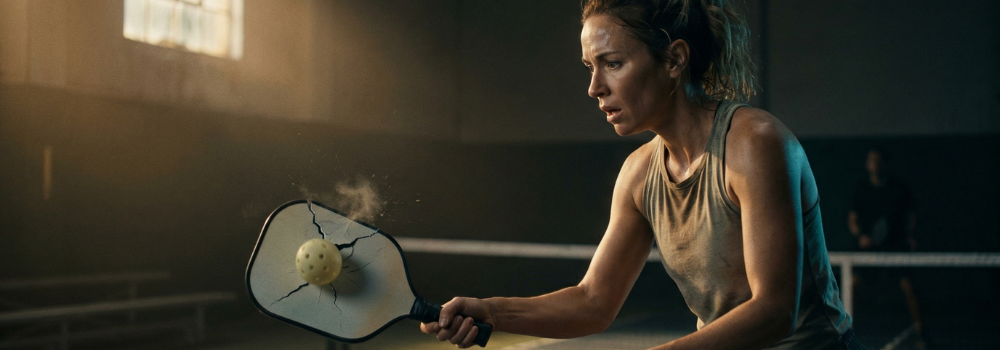
The most prevalent, yet most frequently misdiagnosed, cause of a dead paddle is a phenomenon known as “core crushing”. The internal core of the vast majority of paddles utilizes a hexagonal honeycomb lattice structure. This geometric design maximizes rigidity while minimizing overall weight. However, repeated high-velocity impacts—particularly from aggressive baseline drives, overhead smashes, and heavy volleys—cause these microscopic cellular walls to fatigue over time. Eventually, the structural polymer buckles and collapses under the repetitive stress.
When the honeycomb core crushes, the paddle loses its structural rigidity in localized zones. This failure almost always begins directly in the geometric center of the sweet spot, as this area sustains the highest concentration of impact forces. Instead of the paddle face flexing and rebounding symmetrically as a unified plane, the crushed zone dampens the impact. The kinetic energy generated by the player’s swing is absorbed into the broken polymer cells rather than being transferred efficiently to the ball.
The resulting performance deficit is a dramatic loss of “pop” and exit velocity. Players often describe the paddle as feeling “mushy” or complain that their perfectly timed drives are inexplicably landing short into the net. Because core failures occur gradually over months of play via microscopic structural failures and aging adhesive layers, players frequently fail to notice the decline. Instead of replacing the dead equipment, they attempt to overcompensate by swinging harder or altering their grip pressure. This subconscious adjustment disrupts established biomechanics and significantly increases the mechanical strain on the elbow and shoulder, serving as a primary catalyst for tendonitis.
- The Tap Test: Hold the paddle by the handle and use a single knuckle to firmly tap across the entire surface of the face in a grid pattern. A paddle suffering from cellular collapse will produce a noticeably flat, muted, or “dull thud” in compromised areas.
- The Crunch Test: Place the paddle flat on a sturdy surface and press both thumbs forcefully into the center of the sweet spot. If a subtle “crunching” sound is heard, or if the face exhibits inward give under pressure, the honeycomb lattice is destroyed.
- The Bounce Test: Drop a pickleball from a uniform height onto various horizontal zones of the paddle face. If the ball consistently “dies” or fails to rebound in specific zones compared to the edges, those areas represent definitive core failure.
Face Delamination and The Trampoline Effect
While core crushing dampens a paddle, a condition known as delamination makes the equipment highly erratic, dangerously unpredictable, and technically illegal for sanctioned tournament play. Delamination occurs when the outer hitting surface physically separates from the internal honeycomb core, indicating a complete failure of the chemical adhesive bonds holding the paddle together. This separation creates microscopic air pockets trapped between the layers of the paddle.
When a ball strikes a delaminated zone, the separated face material operates independently from the core structure. The face flexes inward into the void and then snaps back outward with excessive, unregulated force—a biomechanical phenomenon referred to in the industry as the “trampoline effect”. While some amateur players mistakenly welcome this failure because it can temporarily produce massive, effortless power surges, delamination completely destroys a player’s touch, control, and directional accuracy. Consistency becomes impossible, as shots struck with the exact same mechanics will yield wildly different exit velocities.
The auditory profile of a delaminated paddle is distinct and unmistakable. Striking a ball with a delaminated paddle often produces a sharp, hollow, vibrating “buzz” or “hum” that reverberates through the handle. To test for early-stage delamination, grab the paddle tightly by the handle, hold it near your ear, and shake it vigorously back and forth. A rattling sound indicates that dried adhesive particles have broken loose. Any visible lifting or bubbling of the face away from the core is definitive proof of delamination.
Surface Friction Degradation and Grit Wear
In the high-stakes landscape of modern pickleball, the manipulation of spin is a paramount tactical necessity. Contemporary paddle faces utilize raw carbon fiber, specialized peel-ply textures, and applied grit coatings engineered to maximize the coefficient of friction upon ball contact. This micro-texture grips the smooth plastic surface of the pickleball, allowing players to generate massive topspin or heavy underspin.
With every heavy spin shot, microscopic particles of the paddle’s grit are worn away. Once this surface texture wears smooth, the paddle’s coefficient of friction drops precipitously. The ball will begin to slide indiscriminately across the face upon impact rather than gripping it. For the player, this manifests as topspin drives inexplicably sailing several feet beyond the baseline, and delicate slice returns popping up uncontrollably into the strike zone of the opponent.
Diagnosing grit wear is primarily a tactile exercise; players should lightly drag their fingertips across the center of the sweet spot and compare the texture to the extreme outer edges of the paddle near the handle. If the central hitting zone feels glassy or completely smooth to the touch while the edges retain their abrasive bite, the paddle is no longer fit for high-level tactical play.
Structural Fatigue, Edge Guard Failure, and Handle Integrity
The perimeter edge guard of a pickleball paddle serves a critical structural purpose: it clamps the composite layers of the face and core together under tension and hermetically seals the internal honeycomb structure against ambient moisture and court debris. If the edge guard begins to peel, warp, or detach, it significantly alters the paddle’s overall weight distribution and shifts the sweet spot. Once moisture penetrates the core, it degrades the internal glues, inevitably leading to rapid delamination.
Equally critical to the paddle’s lifespan is the structural integrity of the handle. Any looseness, clicking, or twisting sensation in the grip relative to the paddle face indicates a compromised internal tang or fractured handle substructure. A wobbly handle destroys the player’s ability to control the angle of the paddle face upon contact and represents a severe safety hazard.
| Degradation Mechanism | Primary Biomechanical & Play Symptoms | Objective Diagnostic Action | Recommended Response Protocol |
|---|---|---|---|
| Core Crushing | Severe loss of power, localized dead spots, “mushy” impact sensation, compensatory elbow strain. | Tap Test (listen for dull thud), Crunch Test (listen for structural collapse), Bounce Test. | Replace immediately. Structural failure is non-repairable. |
| Face Delamination | Erratic exit velocities, trampoline effect, hollow acoustic buzz upon impact. | Visual inspection for surface bubbling, shake test for internal rattling, tactile inspection. | Replace immediately. Equipment violates USA Pickleball regulations. |
| Grit Wear / Friction Loss | Inability to generate topspin, drives sailing long, loss of slice control. | Tactile inspection comparing sweet spot friction to the paddle’s outer perimeter edges. | Replace within 2-6 months for competitive players relying on spin dynamics. |
| Edge Guard Separation | Shifting swing weight, exposed internal core, altered sweet spot dynamics. | Visual inspection of the perimeter seal and clamp integrity. | Re-glue if minor; replace completely if core is exposed to ambient moisture. |
| Handle Substructure Fatigue | Torsional wobbling or twisting grip during heavy swings or off-center blocks. | Gently twist the paddle head and handle in opposite directions to check for play. | Replace immediately to prevent catastrophic mid-swing breakage. |
Part 2: Footwear Kinematics and Lateral Support Failure
While the paddle serves as the interface between the player and the ball, specialized court footwear serves as the critical interface between the player and the unyielding surface of the court.
“A profound and dangerous misconception among amateur players entering the sport is the utilization of standard running shoes for pickleball competition.”
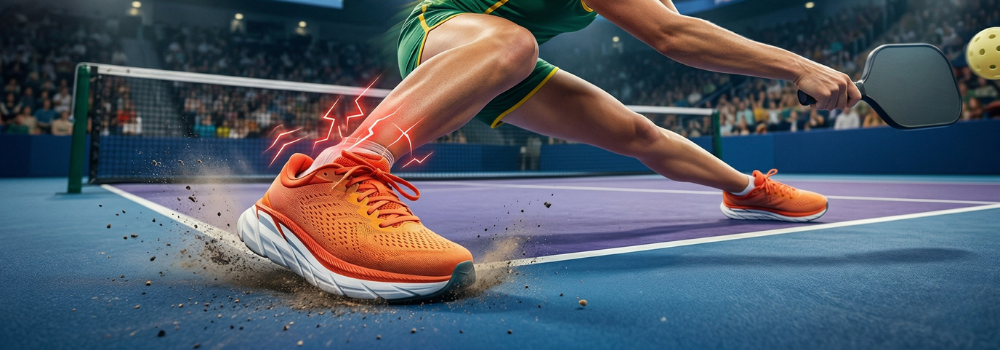
The biomechanics of running dictate strict linear motion; running shoes are heavily engineered with thick, exceptionally soft, elevated EVA foam midsoles designed specifically to absorb the heel-to-toe strike pattern of a forward gait. Pickleball kinematics, conversely, are entirely dominated by explosive, multi-directional movements: sharp lateral cuts, abrupt decelerations at the non-volley zone, and rapid backward diagonal shuffling.
Wearing a linear running shoe during a lateral lunge creates a severe biomechanical lever arm. The soft, elevated midsole lacks any lateral containment, causing the foot to slide over the edge of the footbed. This drastically increases the probability of violent ankle inversions, catastrophic ligament sprains, and knee torsion. Purpose-built pickleball court shoes mitigate these risks by incorporating flat, high-density rubber outsoles for maximum floor contact, firmer midsoles for immediate kinetic response, and rigid thermoplastic polyurethane (TPU) shanks to provide absolute multi-directional stability.
| Player Frequency (Days/Week) | Estimated Optimal Shoe Lifespan | Primary Biomechanical Replacement Triggers |
|---|---|---|
| 1 Day (Recreational) | 10–12 months | Light to moderate tread wear, slight midsole foam compression. |
| 2 Days (Casual) | 4–6 months | Detectable grip loss, arch fatigue, minor creasing across the synthetic upper. |
| 3–5 Days (Competitive) | 2–3 months | Slipping during abrupt stops, reduced bounce-back, post-match joint discomfort. |
| 6+ Days (Elite/Professional) | 1–2 months | Completely flattened outsoles, thermal hotspots, localized knee or lower back pain. |
Midsole Compression and the Loss of Shock Absorption
The midsole is the biomechanical engine of the court shoe. With every step, split-step, jump, and heavy landing, the athlete’s body weight violently compresses the microscopic cellular structure of this foam. Over time, this repeated compression causes the foam to lose its elasticity. When the midsole “bottoms out,” the kinetic shock of striking the concrete bypasses the protective layer of the shoe and travels directly up the human kinetic chain. This failure manifests physically as acute plantar fasciitis, severe shin splints, patellar tendonitis (knee pain), and debilitating lower back fatigue.
Outsole Tread Eradication and the Loss of Traction
The friction generated by constantly pivoting and dragging the foot at the kitchen line aggressively sands down the protective rubber outsole over time. The primary wear zones on a pickleball shoe are typically the medial toe box and the lateral edge of the heel. If any section of the tread pattern has worn completely flat and smooth, the shoe’s ability to grip the court is eradicated. Continuing to compete on bald, treadless outsoles exponentially increases the risk of slipping during deceleration.
The Diagnostic 3-Point Footwear Stability Test
To objectively evaluate whether a court shoe has retained its necessary structural support and is safe for continued play, athletes should regularly perform the podiatric 3-Point Stability Test:
- The Squish Test (Heel Counter Integrity): Firmly grasp the heel of the shoe in the palm of the hand and attempt to squeeze it inward. It must remain firm and highly resistant to lateral compression. If the heel collapses easily, it can no longer lock the heel in place during multidirectional movement.
- The Twist Test (Torsional Rigidity): Hold the shoe firmly by the heel in one hand and grasp the toe box in the other. Attempt to twist the shoe in opposite directions. The shoe should highly resist the twisting motion. If it twists easily or folds over, its torsional stability has catastrophically failed.
- The Flex Test (Forefoot Breakpoint): Place the heel of the shoe firmly on a table at a 45-degree angle, pressing the toe region down. The shoe should only bend at one specific location: the flex point corresponding exactly to where the anatomical joints of the toes bend. If the shoe folds directly in half at the midfoot arch, the structural chassis is broken.
Part 3: The Ancillary Equipment Ecosystem and Consumables
While carbon fiber paddles and biomechanically engineered shoes form the primary interfaces of the sport, the ancillary equipment ecosystem follows strict degradation curves that demand rigorous monitoring.
Pickleball Aerodynamics, Structural Fatigue, and Line Calling
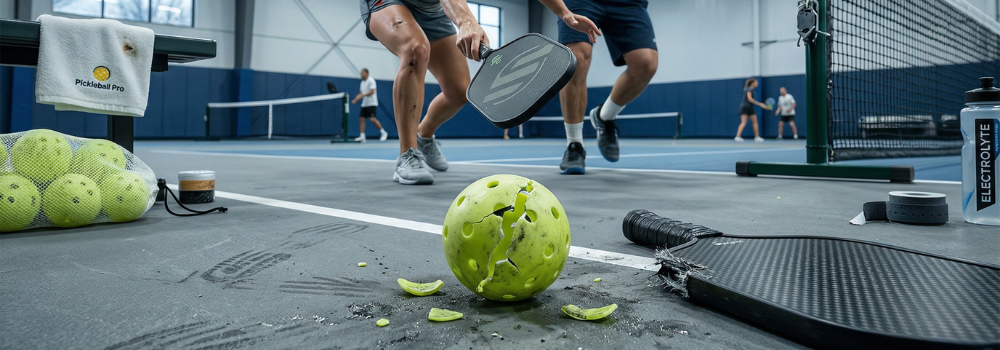
Because pickleballs are constructed from specialized, hard plastic polymers, their functional lifespan varies dramatically based on ambient temperature, court surface abrasiveness, and the overall velocity of play. Players must rigorously test balls for four specific modes of failure:
- Micro-Cracking: Any microscopic fissure along the seam of the ball completely alters the aerodynamic flight path and causes the ball to die off the paddle face.
- Structural Soft Spots: Repeated high-velocity impact causes the polymer to lose its rigidity. If pressing the thumbs firmly into the ball reveals yielding zones, it will no longer bounce to regulation height.
- Out-of-Round Deformation: The intense kinetic force of high-speed drives gradually warps the spherical integrity of the ball. An out-of-round ball makes accurate shot placement impossible.
- Surface Smoothing: Outdoor balls require a slightly rough exterior surface texture to physically grip the air and the paddle face. When the ball becomes entirely smooth, it will skid uncontrollably.
Grip Tape Maintenance and Forearm Biomechanics
As an overgrip loses its tackiness and becomes slick from moisture and degradation, the player unconsciously increases their baseline grip pressure—a clinical phenomenon known as the “death grip”. This sustained, extreme isometric tension travels directly up the forearm and is a primary, direct contributor to lateral epicondylitis (pickleball elbow). Recreational and club players should proactively replace overgrips every 20 to 30 hours of play. Replacing a worn $3 overgrip is arguably the most cost-effective medical intervention available in the sport.
Protective Eyewear Polycarbonate Degradation
Prolonged exposure to harsh UV radiation during outdoor play causes polycarbonate safety lenses to slowly break down at a molecular level, severely compromising their tensile strength. Even if safety glasses appear fully intact, the invisible degradation of the polycarbonate matrix means the lenses may shatter inward upon a high-speed impact rather than safely deflecting the ball. Industry safety standards mandate that protective sports eyewear must be proactively replaced every 1 to 3 years.
Part 4: Advanced Lifecycle Management at Center Court
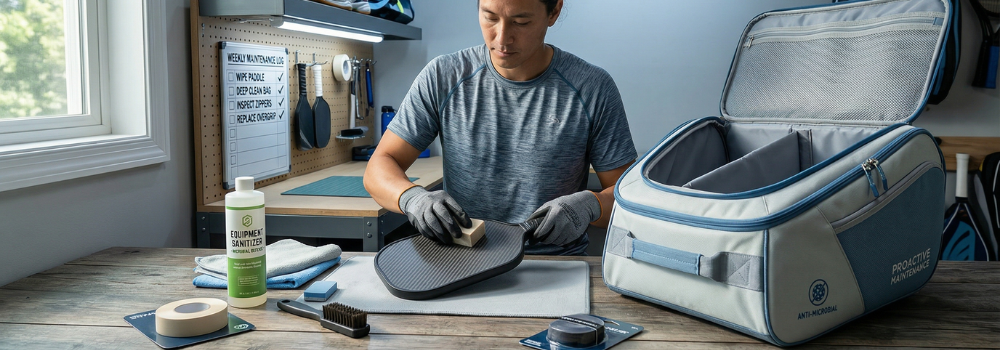
Managing the degradation of high-performance athletic gear requires a highly proactive, systematic approach rather than a reactive one. To maximize the financial value and athletic performance of their equipment investments, players are strongly advised to adopt the following structured maintenance protocol:
- Daily Post-Match Micro-Maintenance (5 Minutes): Immediately upon stepping off the court, paddles must be wiped down using a microfiber cloth to extract abrasive court dust. Damp clothing and shoes must be isolated to halt microbial transfer.
- Environmental Shielding and Storage: Equipment must never be stored in the trunk of a vehicle. Temperatures inside a closed car can easily exceed 140°F in direct sunlight, which rapidly cooks and destroys the thermodynamic adhesives binding paddle faces and shoe midsoles.
- Weekly and Monthly Diagnostic Audits: Monthly, players must dedicate time to conducting the full suite of diagnostic tests outlined in this report: the paddle Tap and Crunch tests, and the podiatric 3-Point Stability Test for footwear.
Integrating Smart Technology and AI into Equipment Lifecycles
Looking forward through 2026, the intersection of equipment and technology offers players unprecedented insights into their gear. The introduction of “smart paddles” integrates microscopic sensors directly into the carbon fiber architecture. When a player notices a sudden, unexplained drop in their recorded exit velocity or spin rate data despite consistent mechanics, it serves as an early-warning diagnostic indicator that the paddle’s core or grit is degrading, long before human tactile senses might detect the failure.
Conclusion
The evolution of pickleball equipment into the highly technical, aerospace-influenced landscape of 2026 demands that players evolve their understanding of material degradation alongside their on-court tactical strategies. The tools of the modern game are highly tuned, sensitive instruments. When a honeycomb polymer core crushes, when an EVA foam midsole compresses beyond its elastic limit, or when a carbon fiber face delaminates, it is the player’s kinetic chain, joints, and competitive confidence that pay the ultimate price.
By diligently applying the exhaustive diagnostic checklists and material science principles detailed within this report, players can accurately and confidently identify the precise moment their gear transitions from a competitive asset to a biomechanical liability. Through vigilant maintenance, proactive testing, and timely replacements utilizing the elite, curated selections available at the Center Court Pickleball Club pro shop, athletes ensure that their gear continually supports their progression, fiercely protects their biomechanics, and elevates their game to its absolute highest potential.