
The Ultimate Guide to Pickleball Doubles Communication: Mastering the Middle Ball, Switching, and Court Control

In the fast-paced world of pickleball doubles, you can have two highly skilled athletes on the same side of the net, but if they cannot communicate effectively, they will routinely lose to a less athletic, yet highly coordinated team. Up to 70 to 80 percent of unforced errors in doubles stem directly from communication breakdowns—missed calls, late calls, or no calls at all. The hallmark of an elite doubles pairing is not just their shot-making ability, but their seamless synergy, moving as a single unit and anticipating each other’s movements.
If you find yourself constantly clashing paddles with your partner, shouting “I thought you had it!”, or feeling lost when a lob sails over your head, it is time to upgrade your communication strategy. This comprehensive guide breaks down the essential verbal and non-verbal cues required to master the middle ball, execute flawless switches, pull off aggressive poaches without causing collisions, and build unbreakable team chemistry.
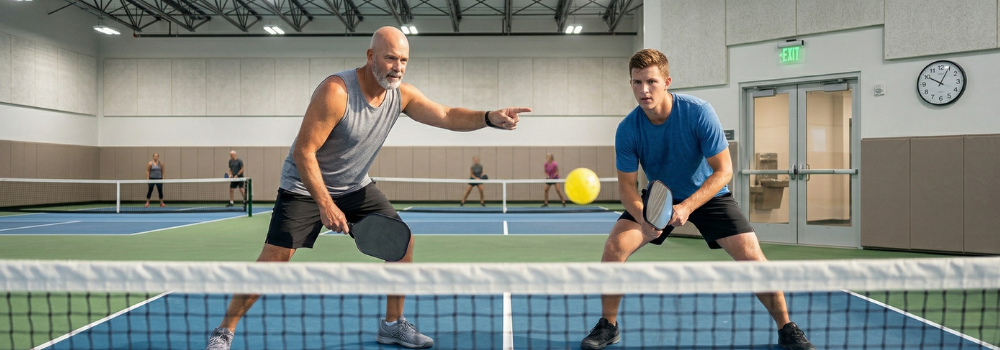
Mastering the Middle Ball: Who Takes It?
The centerline of a pickleball court is the most fiercely contested piece of real estate, acting as a magnet for confusion, hesitation, and paddle clashes. Opponents will relentlessly target the gap between you and your partner to exploit miscommunication. To eliminate ambiguity, you must establish clear frameworks before the first serve is even struck.
The “Forehand Takes the Middle” Rule
A universal rule of thumb at every level of pickleball—from beginners to touring professionals—is that the player with their forehand in the middle takes the shot. The forehand naturally possesses a wider reach, better stability, and superior power compared to a backhand, allowing that player to dictate the pace of the rally. A good baseline is to apply this rule to roughly 80 percent of middle balls.
However, this rule is not absolute. If your partner happens to have a lethal, highly consistent backhand roll, and your forehand is off that day, you must adapt. Pickleball requires flexibility, and rigid adherence to rules without assessing the actual strengths of your team will cost you points.
The “Respect the X” Framework
When standing at the Non-Volley Zone (kitchen) line, the “Respect the X” rule is vital for geometric court coverage. This theory states that a ball traveling diagonally (cross-court) is the primary responsibility of the player standing on the far end of that diagonal path. If a ball is hit cross-court toward your side, the angle naturally brings the ball into your strike zone, making it your responsibility. Reaching awkwardly across the “X” to steal your partner’s cross-court dink pulls you out of balance, creates massive gaps on your side of the court, and often leads to weak pop-ups.
The Lefty-Righty Fortress
When a right-handed player and a left-handed player team up, the dynamic shifts entirely. If positioned optimally (the righty on the left side, and the lefty on the right side), both players have their forehands in the middle. This creates a terrifying two-on-one “funnel” that dominates the center of the court. However, without communication, having two forehands in the middle leads to dangerous collisions. Lefty-righty teams must communicate extensively before the match to decide who has the absolute right of way—often giving priority to the player with the stronger, more aggressive drive.
Verbal Communication: The Power of One-Word Calls
In the heat of a 40-shot dink rally or a lightning-fast hand battle, you do not have time for full sentences. The brain processes simple, single-syllable sounds much faster.
“Mine!” and “Yours!” (or “Me!” and “You!”)
A loud, authoritative “Mine!” or “Yours!” is the gold standard for calling shots. Avoid phrases like “I got it,” or “You take it,” as they take too long to say and the blending syllables can sound identical over the noise of the court. If you are not calling your shots loudly, you are simply guessing what your partner is doing, which guarantees eventual failure.
“Bounce!”
When a high ball is floating toward the baseline, it is incredibly difficult for the player tracking it backward to judge whether it will land in or out. The partner who is not hitting the ball has a much better perspective. Yelling “Bounce!” commands your partner to let the ball hit the ground, preventing them from swinging at an out-ball.
“Switch!” and “Stay!”
Court positioning changes rapidly. If you are forced out of your zone, or if you hit a weak, floating drop shot that invites an attack, using commands like “Stay!” tells your partner to hold their defensive position rather than rushing forward into a trap.
Handling the Lob: How to Call a “Switch” Without Crashing
The lob is the ultimate agent of chaos in doubles. When you are both positioned tightly at the kitchen line and your opponent hits a high lob over your head, human instinct often triggers a frantic, backwards backpedaling motion—which is both highly dangerous and ineffective.
The safest and most strategic way to handle a deep, well-placed lob is for the player who was not lobbed over to retrieve it. Because this player is looking across the court rather than straight up, they have a better forward-facing view of the ball’s trajectory.
The non-lobbed player immediately turns, runs in an arcing “J-curve” toward the baseline to track down the ball, and screams, “Switch!” Upon hearing “Switch!”, the player who was originally lobbed over must instantly slide laterally across the kitchen line to cover the opposite side of the court.
This synchronized rotation ensures that the backcourt player has a clear lane to return the ball, the kitchen line remains protected, and the two partners do not collide in a blind panic.
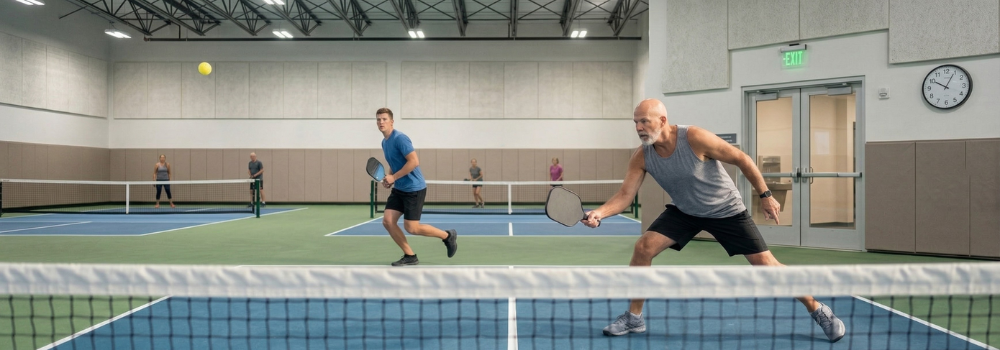
The Art of the Poach
Poaching occurs when a player aggressively crosses the centerline into their partner’s side of the court to intercept a ball out of the air. When executed correctly, a poach suffocates the opponent’s reaction time, disrupts their rhythm, and secures an outright winner.
However, a failed poach that is not communicated is a disaster. When you cross the centerline to attack, you abandon your half of the court. If your opponents block your poach, they will easily pass the ball into the massive void you left behind. Therefore, when you commit to a poach, you must yell “Switch!” so your partner knows to slide over behind you and fill the gap. You either fully commit to the poach with loud communication, or you do not go at all. Half-hearted poaching leads to lost points.
Pre-Point Hand Signals and Stacking
To execute advanced maneuvers like poaching or “stacking” (where partners purposefully arrange themselves to keep their best forehand in the middle), elite teams use silent hand signals before the serve or return. These signals are flashed behind the back or behind the paddle to hide the strategy from the opposition.
Open Hand (or Thumbs Up): This signals a “Switch” or a “Stack”. It means that as soon as the ball is struck, you and your partner will rapidly swap sides of the court.
Closed Fist (or Thumbs Down): This signals “Stay.” It tells your partner to hold their current position. A “fake switch” can also be used here, where players take a hard step toward the middle to confuse the opponent before retreating to their original sides.
Using hand signals ensures both players know exactly where they are supposed to run the millisecond the point begins, completely eliminating the frantic scrambling that plagues intermediate play.
The “String Theory” of Lateral Movement
Once you have successfully navigated your way to the kitchen line, your movement must remain perfectly synchronized. The best doubles teams operate under the “String Theory” of court positioning.
Imagine a 6 to 8-foot string connecting your waist to your partner’s waist. If your partner is pulled wide to the extreme left sideline to return a sharp dink, you cannot simply stand still and watch them. If you stand still, the imaginary string breaks, and you leave a massive, gaping hole right down the middle of your court. Instead, if your partner moves six feet to the left, you must simultaneously slide six feet to the left, shifting toward the centerline to plug the gap. Moving as a unified, tethered pendulum is the ultimate secret to impenetrable defense.
Partner Etiquette: The Psychology of Winning Together
The most overlooked aspect of doubles communication is basic human psychology. A toxic attitude will dismantle team chemistry faster than a bad backhand. Body language speaks volumes. Rolling your eyes, aggressively sighing, or slumping your shoulders after your partner hits a ball into the net immediately drains the energy from your side of the court and emboldens your opponents. You must establish a relentlessly supportive environment.
- Paddle Taps: Offer a quick paddle tap after every point, win or lose.
- Positive Reinforcement: Say things like “We’ll get the next one,” “Good try,” or “Shake it off.”
- No Unsolicited Coaching: The middle of a competitive match is never the time to correct your partner’s mechanical swing path. Offer strategic adjustments if needed, but save the deep coaching critiques for the practice courts.
In the end, doubles pickleball is a shared experience. By defining your middle-court responsibilities, actively screaming for your shots, mastering the lob switch, and bringing a positive, supportive attitude to every match, you will elevate your partnership and dominate the court as a unified force.